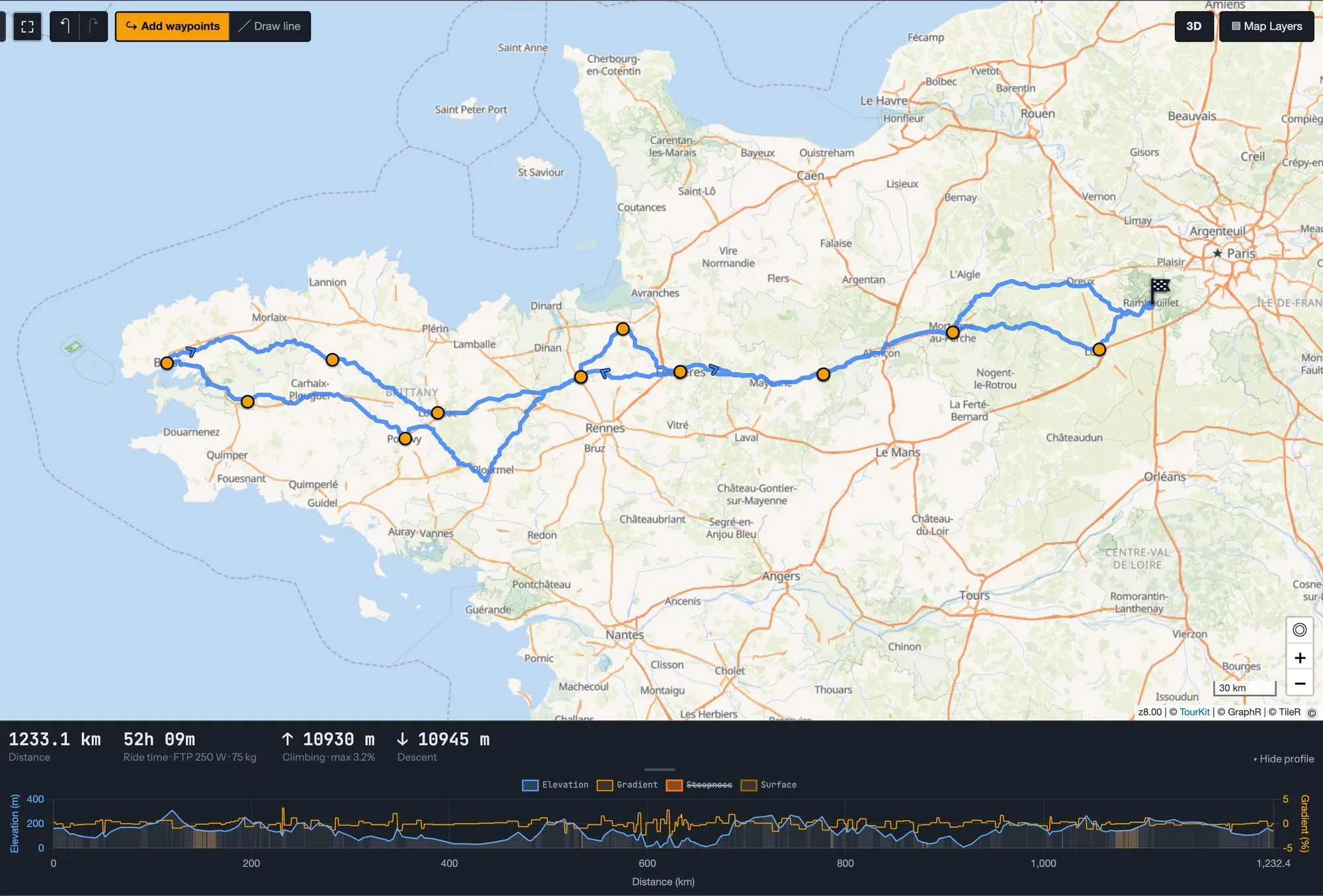
Paris-Brest-Paris leaves Rambouillet on the evening of 22 August 2027. The route is new this time: Pontivy, Pleyben, Callac, Pleine-Fougères and Chartres join the list of control towns. Most riders have 90 hours.
We paced the route for four riders, to see where those 90 hours actually go.
Four riders
| Weight | FTP | |
|---|---|---|
| A · light climber | 62 kg | 230 W |
| B · typical randonneur | 78 kg | 220 W |
| C · big diesel | 92 kg | 280 W |
| D · first PBP | 70 kg | 180 W |
Each rider's name opens their plan at 62% in Pacer, with the clock below.
Road bike, steady effort: climbs at a chosen share of FTP, flats at 72% of it, freewheeling down the descents. And the effort falls as the hours go by, 7% for every 10 hours of riding, the rate that matched riders' times on Paris-Brest-Paris 2023: Six riders' Paris-Brest-Paris 2023, and how close Pacer came.
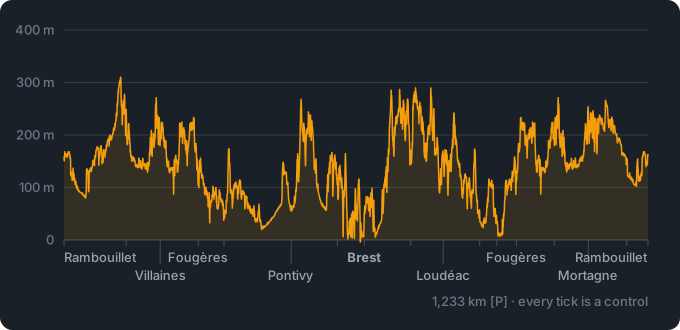
It's a rolling course, not a mountain one
For rider B, 40% of the moving time is on the flat and 22% on drags of 1 to 3%. Only about one hour in five is on climbs of 3% or more, and the biggest climbs are under 75 m, none longer than about 13 minutes. PBP's climbing comes in hundreds of short rises, so the pacing that matters is on the rises: steady, seated, the same effort each time.
What 90 hours buys
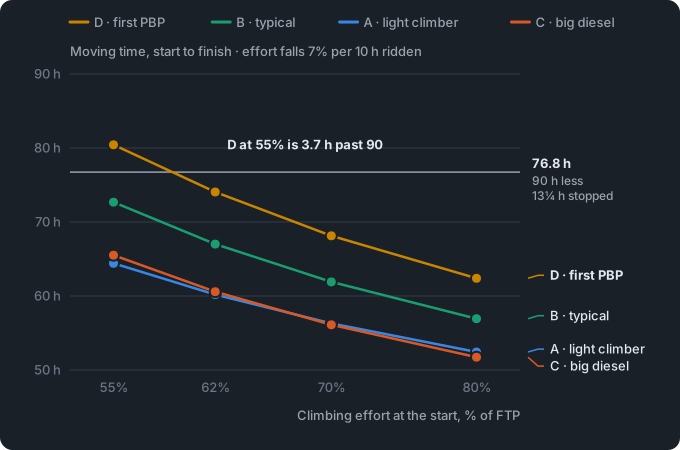
Moving time at four starting efforts, each falling 7% for every 10 hours ridden:
| Rider | 55% | 62% | 70% | 80% |
|---|---|---|---|---|
| A · light climber | 64 h | 60 h | 56 h | 52 h |
| B · typical | 73 h | 67 h | 62 h | 57 h |
| C · big diesel | 66 h | 61 h | 56 h | 52 h |
| D · first PBP | 80 h | 74 h | 68 h | 62 h |
The rest is yours to spend off the bike. A plan with 30 minutes at each control (15 at the first) and two 3-hour sleeps takes 13¼ hours, which leaves 76¾ hours to ride. Rider D at 55% needs 3.7 hours more than that, so would have to give up most of a sleep to finish. At 62% D has 2.7 hours in hand, and at 70% 8.7 hours.
Each step of effort is worth four to six and a half hours of riding, the most for the slowest rider. That is the choice PBP really asks you to make: ride a little harder and sleep more, or ride easier and sleep less. For a first PBP on 180 W, it decides whether the ride fits at all.
And this plan has no stops between controls. The 2023 riders lost a median of 8% of their ride to them: a café, a bench, a puncture, a nap in a bus shelter. At that, rider B at 62% keeps 2.4 hours in hand, and rider D at 62% is 5.3 hours over.
Your clock
Rider B at 62%, starting at 18:00 on Sunday, with the plan above:
| Control | Arrive |
|---|---|
| Villaines-la-Juhel | Mon 03:40 |
| Fougères | Mon 08:06 |
| Pontivy (sleep) | Mon 18:19 |
| Brest | Tue 06:52 |
| Loudéac | Tue 17:33 |
| Pleine-Fougères (sleep) | Wed 00:53 |
| Mortagne-au-Perche | Wed 17:19 |
| Rambouillet | Thu 02:07, 80 h |
Rider B's plan has every control: when you arrive, the early and late end of the band, how long you stop, and how much time is in hand against the 90 hours.
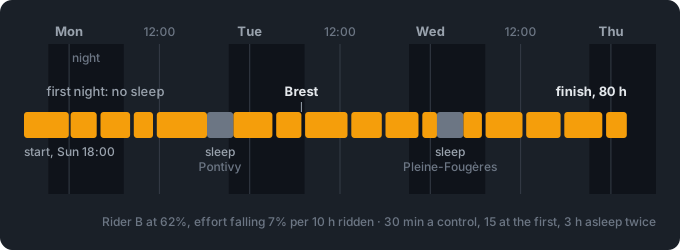
The first night is ridden straight through. Plan your lights, your food and your first sleep around that night, not around the distance. And as the effort falls, the last night comes too: rider B rides it into Rambouillet in the small hours of Thursday.
Aero bars are worth over an hour
Rider B at 62%: aero bars save 1.6 hours over 1,220 km. Sitting upright with a big saddlebag costs 2.6 hours. If you use bars, check what the regulations allow first.
Light or heavy, you finish together
The light climber and the big diesel finish within about an hour of each other at every effort from 55 to 80% of FTP. The climbs aren't long enough to give the light rider much, and the flats give the heavy rider back what they lose.
Do this for your own numbers
- Import the official route when ACP sends it. It stays private in your account.
- Pace it in Pacer with your own FTP, weight and position: the time band, the climbs and the energy for each leg.
- Train for it. Build the training plan from the pace plan, with PBP as the goal: what this ride asks of you against what you can do now.
Pacer is part of Pro.
Try it free at tourk.it
How we worked it out. TourKit's Balanced route between the 2027 controls, not the official route, paced with Pacer's steady strategy on the heights of the ground under it, read every 30 m, with the effort falling 7% for every 10 hours ridden from the start, as Pacer's clock applies it. That fade was measured on riders who rode for 46 to 58 hours; past that, as for rider D at 55%, it runs on beyond what was measured. Road bike defaults (CdA 0.32, rolling resistance 0.005). Moving time only, with a band of 8% either way, because wind and your own position aren't in it. The riders are examples, not real people.
Paris-Brest-Paris is organised by the Audax Club Parisien, and TourKit has no connection with it.